
Context
A founder operating across multiple projects reads more in a day than most teams ship in a quarter — papers, repos, model releases, regulatory drafts. The signal-to-noise ratio is brutal. Standard "AI summariser" tools make the problem worse: they reduce density without raising relevance. SignalOS started from a different premise: do not summarise, decide.
Problem
Every information system the founder tried fell into one of two failure modes. Either it remembered too much (zombie memory — old, irrelevant context bloating every prompt), or it remembered the wrong things (cancer memory — irrelevant nodes treated as load-bearing). Neither mode produced action. Both produced more reading. The actual question — "given everything I am building, what should change today?" — was never answered.
Approach
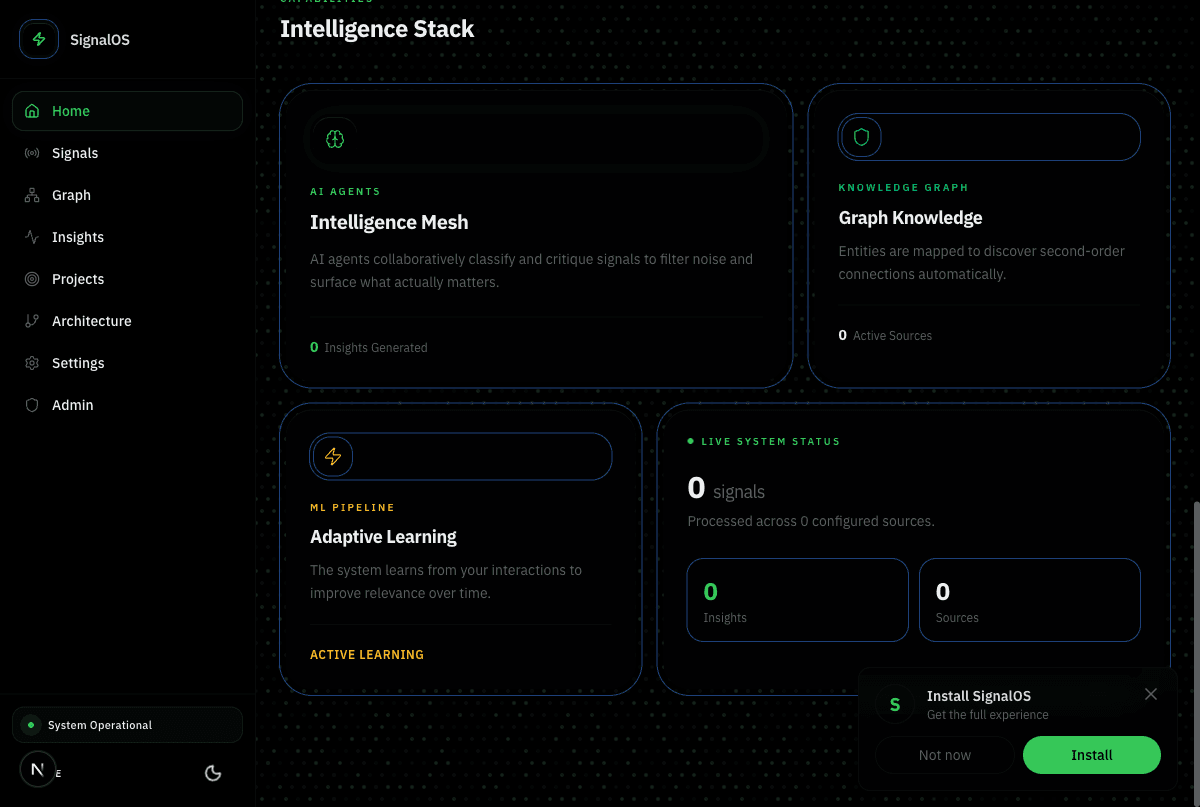
SignalOS is an event-driven graph + vector system with four hard rules built into the substrate: the So-What Imperative (no node without an edge to a User Goal), Epistemic Humility (every insight tagged with confidence and source reliability), Adversarial Integrity (contradictions to locked beliefs trigger a pause, never a silent overwrite), and Temporal Decay (cold storage after 14 days of inactivity). The pipeline runs Sentry → Isomorph → Mirror → Insight — each stage is inspectable, each output is traversable.
System
/ the things actually shipped
- 01
The Sentry — an SLM-backed ingestion filter that drops any signal failing the relevance gate against active goals and project stacks. Most inputs die here. By design.
- 02
The Isomorph — extracts triples from surviving signals, then walks the project graph for structurally isomorphic problem nodes. "Flash-RAG solves latency X" maps to "Z-Brain has latency Y" because the topology matches, not because the keywords do.
- 03
The Cognitive Mirror — runs every hypothesis through hard-constraint and prior-directive checks before it can become a Strategic Directive. A conflict surfaces as a flag, not a fact.
- 04
A hybrid memory: Neo4j for structural logic, Weaviate / pgvector for semantic recall — the graph holds why, the vector store holds where else this has shown up.
- 05
LangGraph orchestrates the stateful reasoning loop. Each insight carries a confidence score and a full traceback to the source signal.
- 06
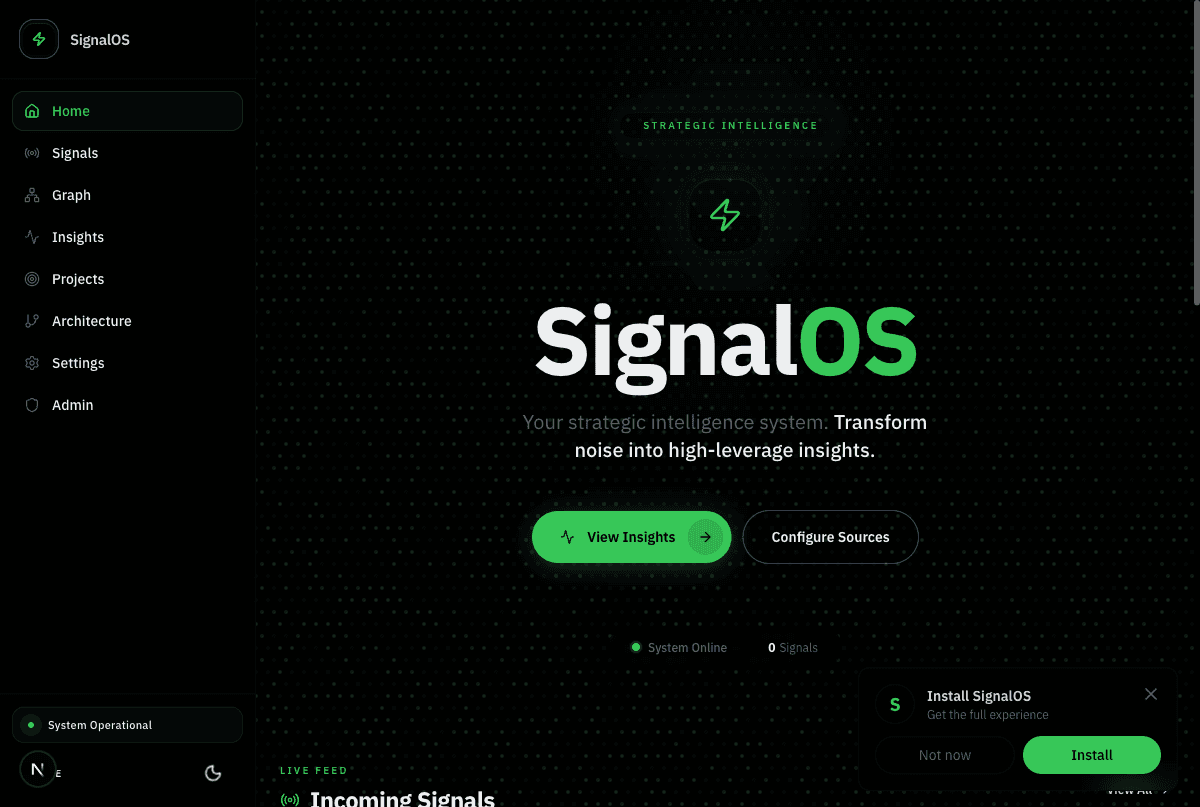
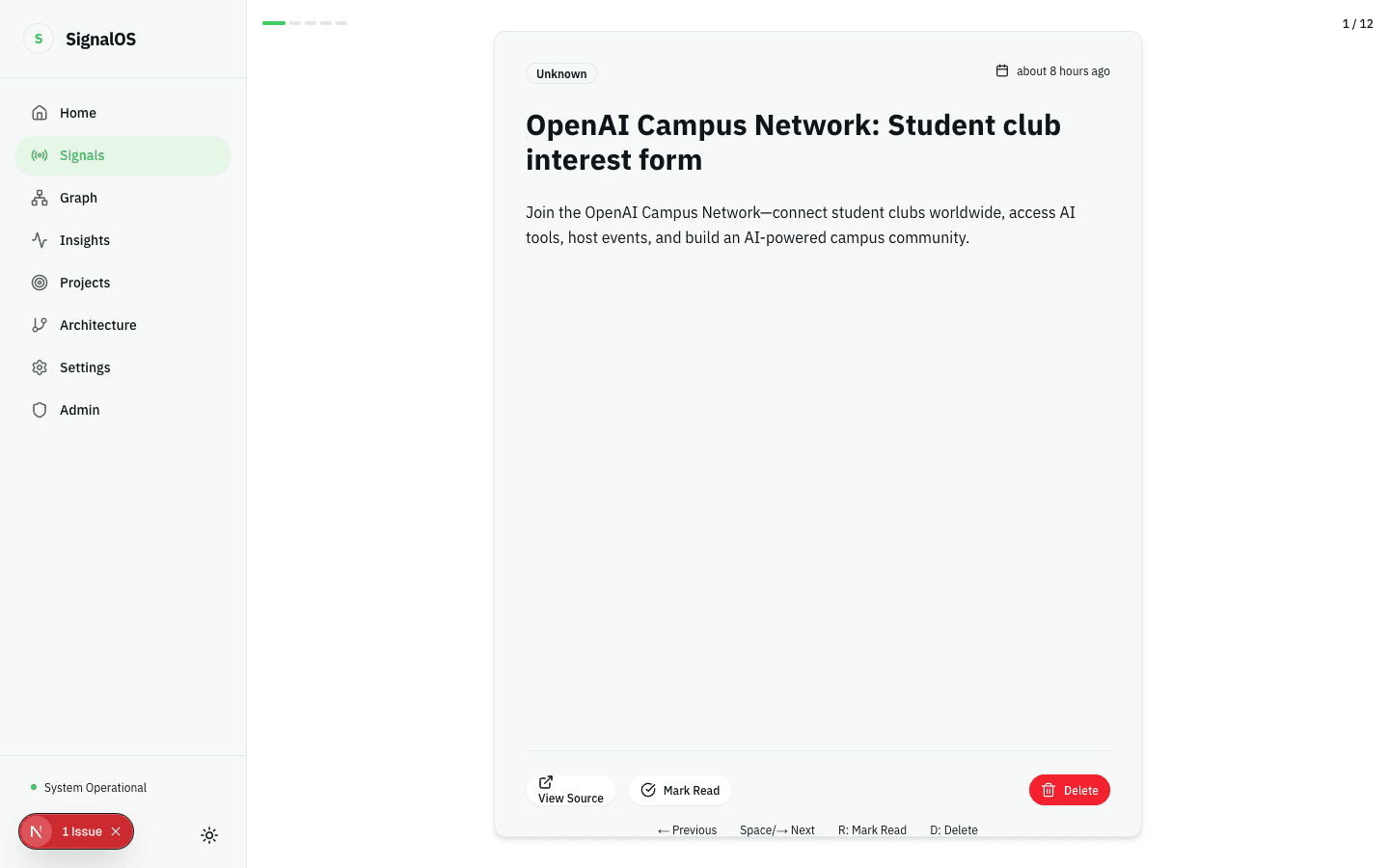
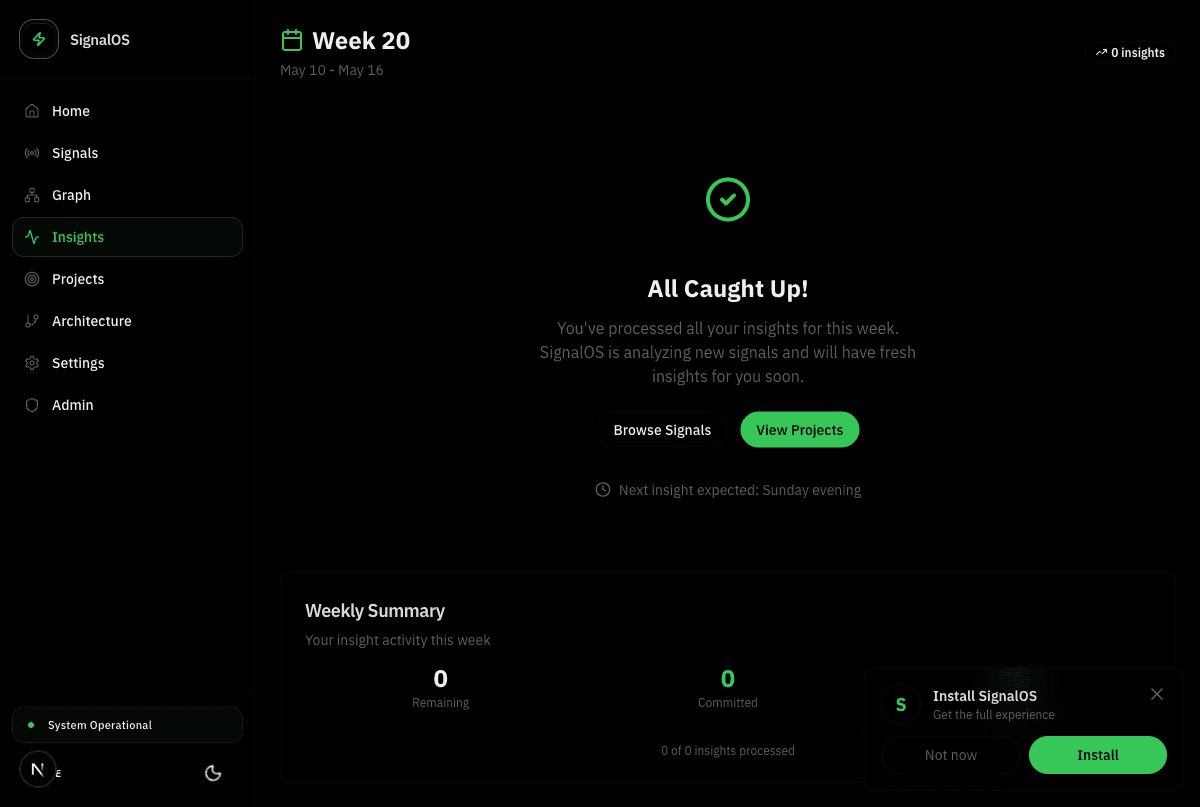
Strategic Directives surface in a daily review surface — voice-first capture, deferred actions, weekly digest — the founder is always the judge, never the maintainer.
In Practice
Selected views from the system, traced for this case study.
How the pieces fit.
Architecture
- Next.js 14
- TypeScript
- Tailwind
- Daily review surface
- Voice capture
- LangGraph
- SLM relevance gate
- Isomorph mapper
- Cognitive Mirror critic
- Neo4j (structure)
- pgvector / Weaviate (semantics)
- Hot / Cold tiering
- Temporal decay worker
- Python
- FastAPI
- Celery
- Alembic
- Redis
- Docker
- Render
- Per-tenant graph isolation
Outcome
SignalOS has compressed the founder's daily intake from hours of reading into a handful of directives — each one already mapped to a specific project, ranked by confidence, with the source signal one click away. The Signal-to-Strategy Ratio — inputs that result in a concrete roadmap change — became a measurable number for the first time. Old context decays on its own; the graph stays sharp.
Learnings
/ what would be different next time
- /01
A relevance gate that drops 90% of inputs is not a bug — it is the product. The hard part was earning the trust to drop them silently.
- /02
Isomorphism is more useful than similarity. The same problem topology shows up across totally unrelated domains; keyword search misses it every time.
- /03
A critic stage in the loop is the only thing that kept the system honest. Hypothesis → insight, with no judge in between, drifts into confident nonsense within a week.
- /04
Temporal decay had to be a structural property, not a cleanup script. The graph that forgets on schedule stays usable; the graph that remembers forever rots.